
Hendrix Hennessy-Ropiha - The Debate Was In 1840
Hendrix Hennessy-Ropiha -1840
Essay by Brooke Pou: The Debate Was In 1840
1840 was shown at McLeavey Gallery, Wellington, 31 July - 15 August 2026
This essay was commissioned to accompany the exhibition and is reproduced here by kind permission of the author and McLeavey gallery.
In 1840, Hendrix Hennessy-Ropiha presents five photographs taken within the past three years. Each tells its own story, but together, they all connect to the wider issue of Māori rights—both historically, and contemporarily.
Through his own writing accompanying this exhibition, Hennessy-Ropiha recalls childhood memories at the Māori Land Court and Waitangi Tribunal, describing himself as “blissfully unaware” of the significance of these early experiences.1 As an adult, he actively seeks out spaces that bring attention to Māori causes to photograph. No Co Governance is dominated by a stretch of State Highway 1 outside of Levin. The road is empty, but on its side is a sign reading:
One Country:- NEW ZEALAND
One People:- NEW ZEALANDER’S
One Vote:- DEMOCRACY
(stop) Racism:- NO CO GOVERNANCE
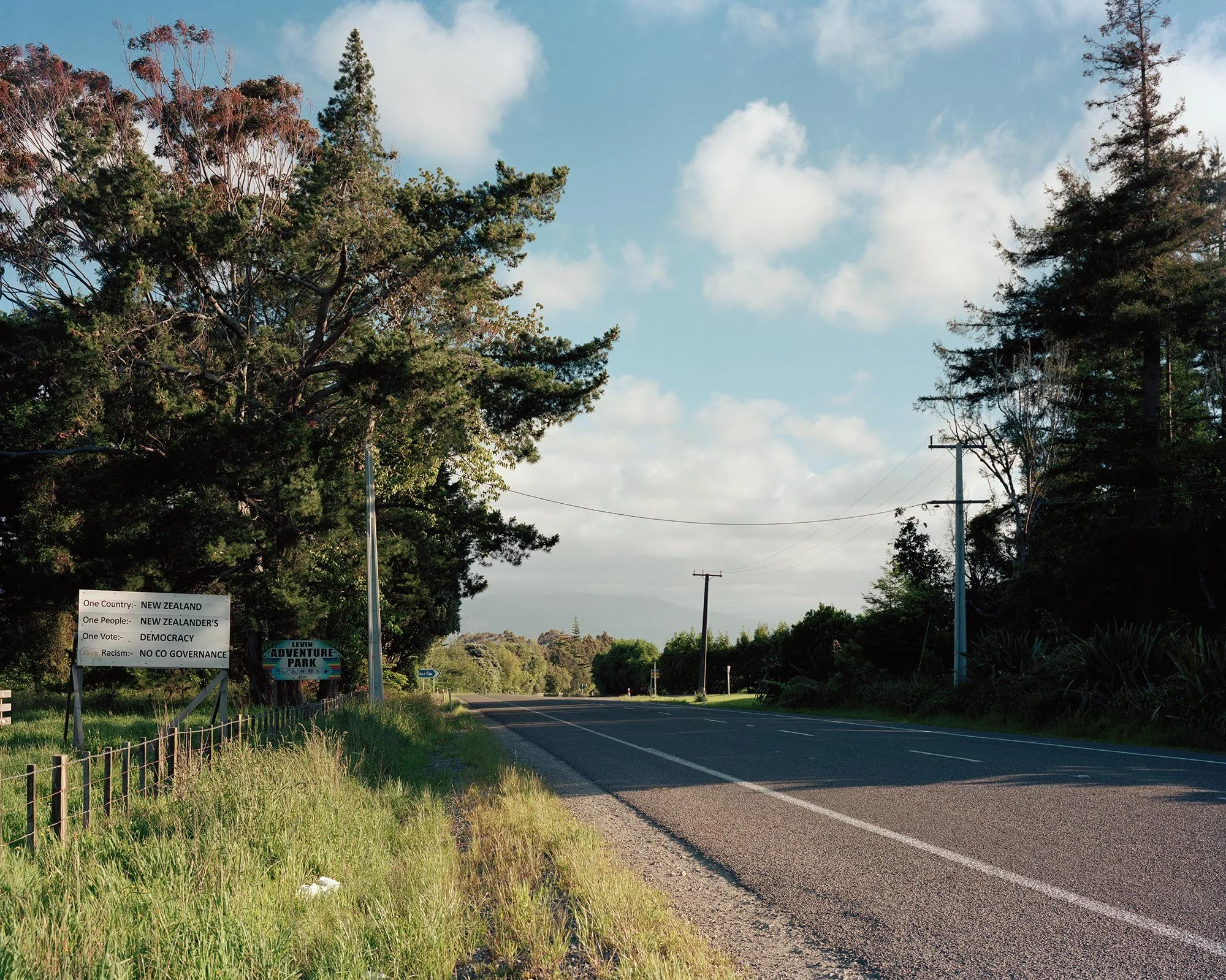
Hendrix Hennessy-Ropiha, No Co Governance, 2026
The Human Rights Commission describes Co-governance as “various arrangements where Māori and the Crown share decision-making power or where Māori exercise a form of self-determination, albeit as a delegation of state power” warranted by te Tiriti o Waitangi.2 Those opposed, like the people who installed this sign, argue that it is undemocratic and grants race based privileges. Behind the sign is another advertising Levin Adventure Park. Ironically, Hennessy-Ropiha remembers wishing for Court and Tribunal visits “to be over so we could go visit the playground.”3
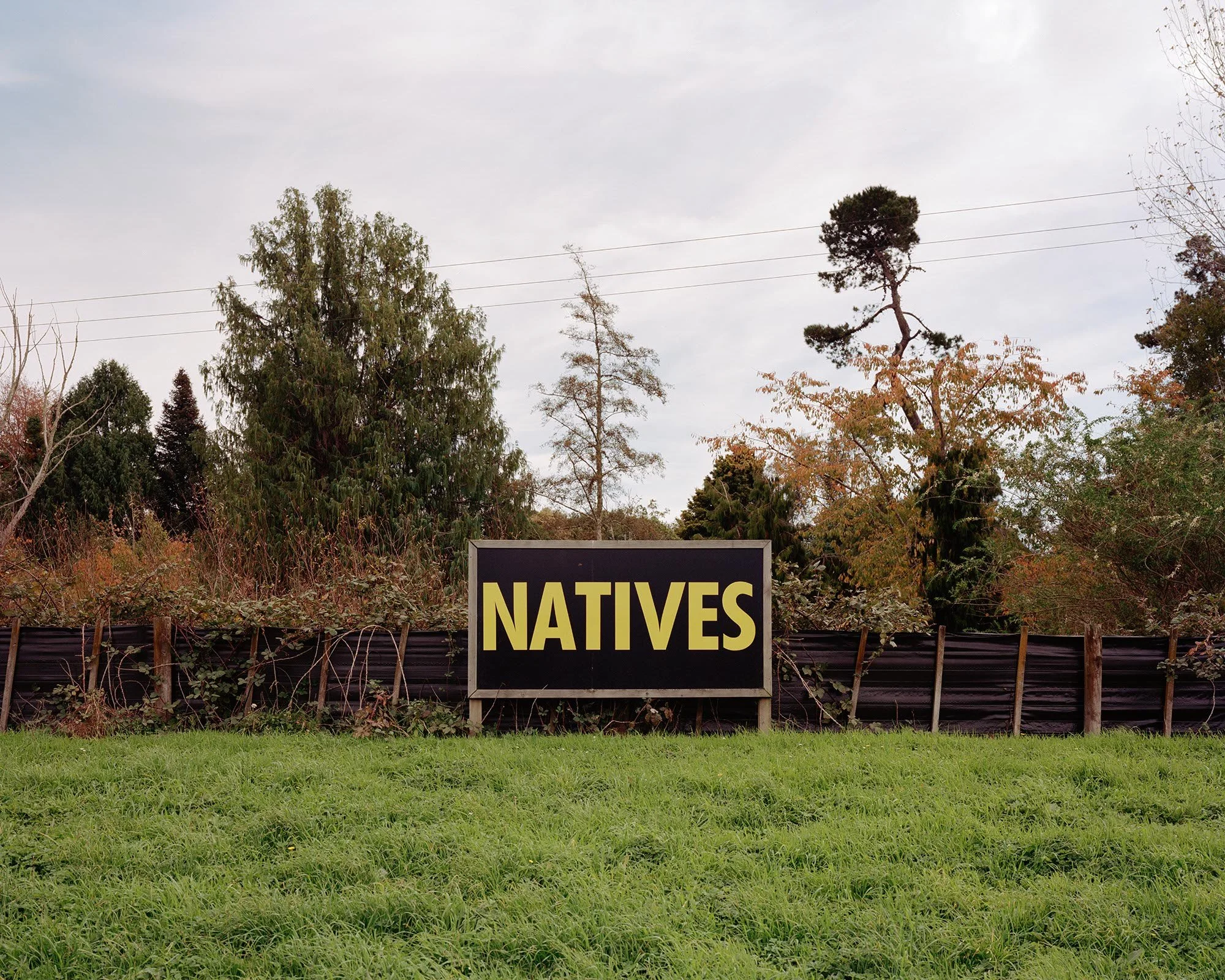
Hendrix Hennessy-Ropiha, Natives, 2025
Along SH1, near a garden centre in Manukau, stands a much larger sign with yellow text reading “NATIVES.” While the word refers to the trees in this location, the artist recontextualises it here, reminding us of language from a by-gone era used to describe tangata whenua. Similarly, his choice to document a diorama from Tairāwhiti Museum’s collection depicting the arrival of Captain Cook is a peek into the past.
From the Journal of Captain Cook, Monday 9th October, 1769:
Gentle breezes and clear weather. PM stood into the Bay and anchored on the NE side before the entrance of a small river...I went ashore with a party of men...but seeing some of the natives on the other side of the river whome I was desirous of speaking with and finding that we could not ford the river, I order'd the yawl in to carry us over and the Pinnace to lay at the entrance.4
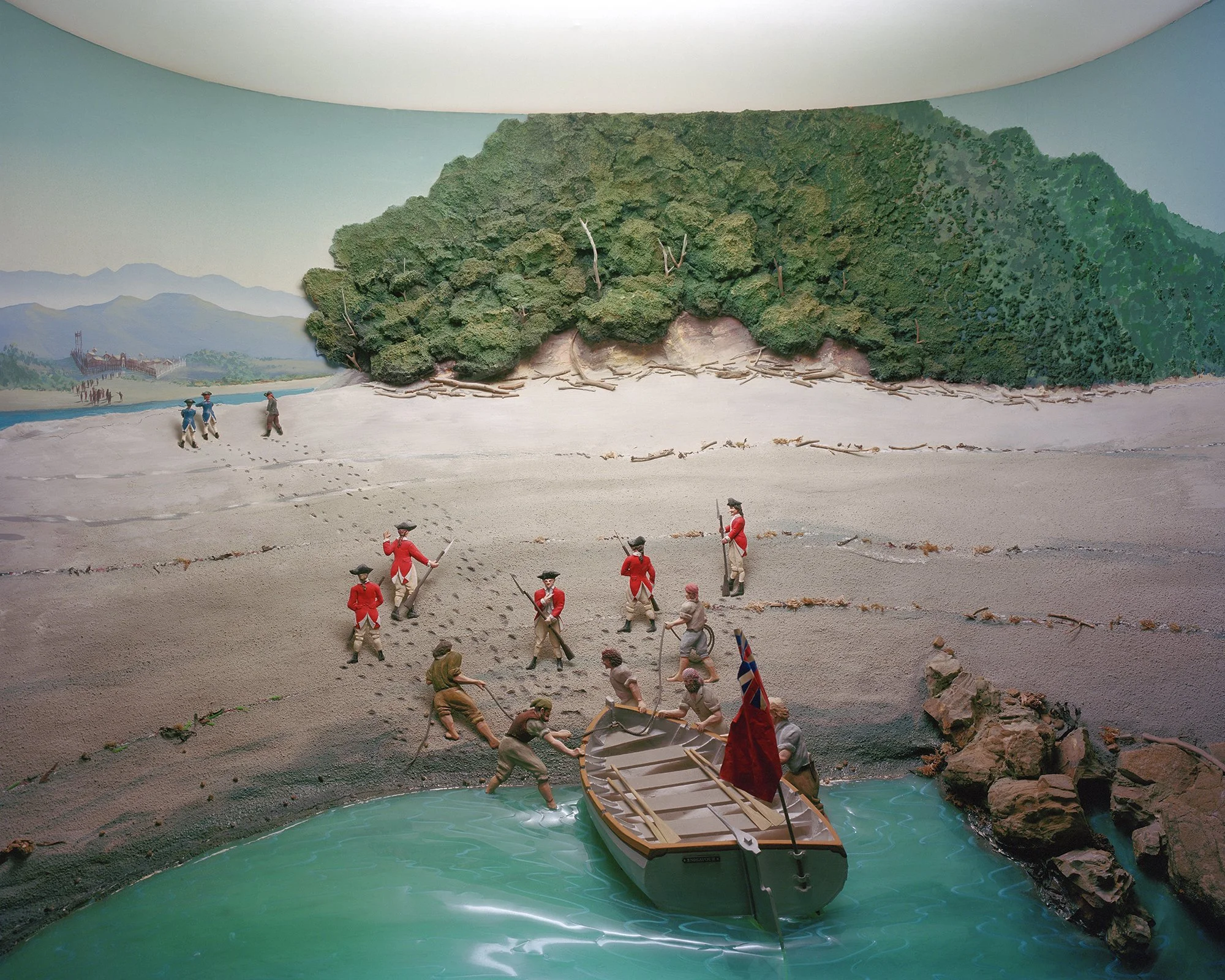
Hendrix Hennessy-Ropiha, 1769, 2025
Cook goes on to describe his men following this group of Māori, before the Coxswain “fired two musquets over their heads.”5 This was the beginning of an attack that would kill nine Māori.
Titled 1769, the artist's photograph of this diorama—made in 1969 for the bicentenary of Cook’s ‘discovery’—at first seemed out of place to me. A diorama is unexpected, but positioned next to Hīkoi mō te Tiriti, makes sense both thematically and visually. The work captures the thought process of its maker, who focuses on depicting Cook and his group of armed men coming ashore via their yawl. The detail in the figures' appearance, such as the colour and style of their clothing and even beards, is a stark contrast to those of the “natives” across the Tūranganui river, who have simply been painted in brown silhouette. Hennessy-Ropiha’s decision to include 1769 in 1840 calls into question dominant narratives of this first ‘encounter’ and encourages audiences to seek other perspectives.
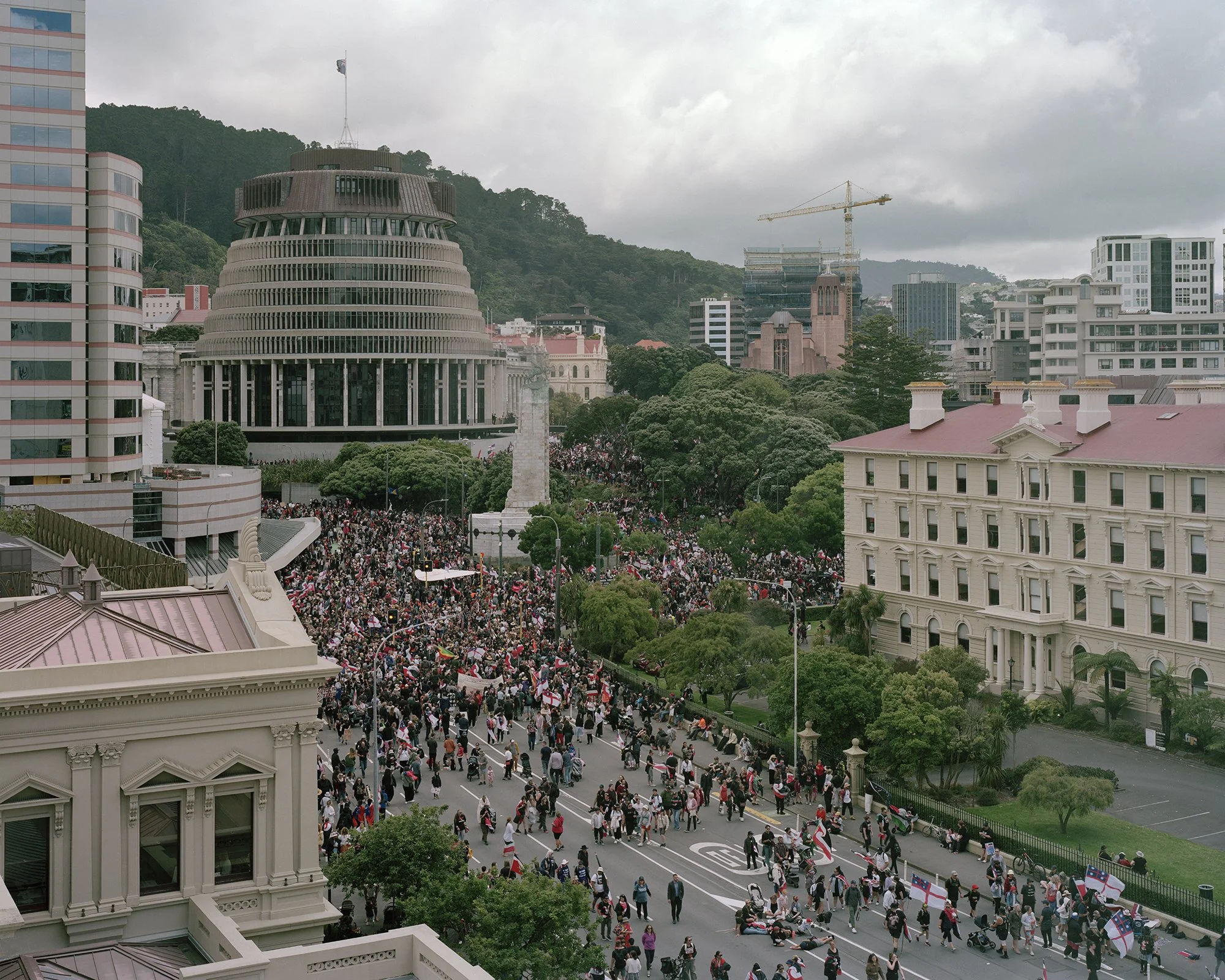
Hendrix Hennessy-Ropiha, Hīkoi mō te Tiriti, 2024
Seventy one years after Cook landed here, Te Tiriti o Waitangi was signed in. 184 years after that, protestors marched across the country in Hīkoi mō te Tiriti, one of the largest protests in this country's history. Marches against the proposed Treaty Principles Bill ended on 19 November, when the hīkoi arrived at Parliament. Hennessy-Ropiha’s photograph captures this moment in such detail that I am told a visitor to the gallery recognised herself in it. Unlike 1769, Hīkoi mō te Tiriti highlights tangata whenua and tangata tiriti.
Countless Tino Rangatiratanga and United Tribes flags are held in hands and wrapped around bodies. The crowd is thick at the Beehive, but on Lambton Quay is dispersed enough for viewers to observe distinct scenes of whānau and friends. In the middle of the road, a group of around ten adults and children sit. They remind me of the way my own nephew, sister-in-law, and I had paused to rest his little legs earlier in the journey.
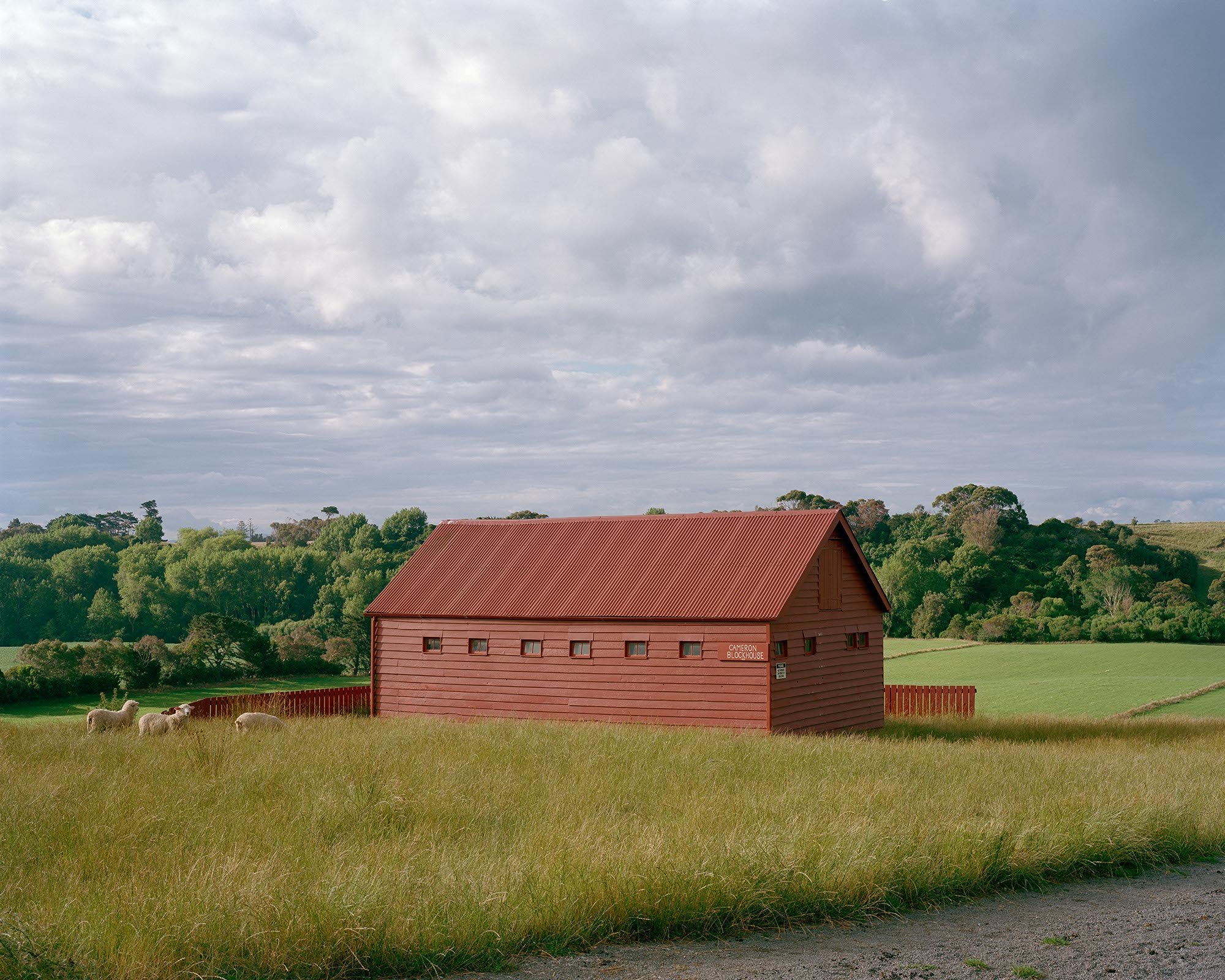
Hendrix Hennessy-Ropiha, Cameron Blockhouse, 2025
In Cameron Blockhouse the artist has composed a quintessentially Kiwi landscape — sheep grazing, the blockhouse’s dark red tōtara walls and matching corrugated iron roof in the centre of the frame, and just over a third of the image covered by ominous clouds.
What is also quintessentially Kiwi? The troubled history of the building and the land it stands on. Located just south of Wanganui, the blockhouse was built on land bought by John Cameron during the New Zealand Wars. After fighting between Māori and the Crown broke out, he fortified the walls with clay to protect from gunfire and installed holes for muskets. I look at this artwork and wonder what Aotearoa would look like if John and settlers like him had understood that Te Tiriti served their interests as well, and acted accordingly.
Walking back down Lambton Quay after the hīkoi, I noticed a sign planted in the median strip reading “The debate was in 1840.” Hendrix Hennessy-Ropiha’s own 1840 offers us fragments of a bigger project—while the debate may have been back then, its effects are ongoing.
1 Hendrix Hennessy-Ropiha, 1840, 2026.
2 The Human Rights Commission, https://tikatangata.org.nz/our-work/co-governance-resource?token=03f66278f1accf53688cff9e86f396f748e70e3e35f4c5f9c6e566b118699f59.
3 Hennessy-Ropiha, 1840, 2026.
4 James Cook, The Journals of Captain Cook, ed. Philip Edwards (London: Penguin Books, 1999), 69.
5 Ibid, 70.